7 Pilates Cues That Mean the Opposite of What You Think
Quick Answer: Most classic Pilates cues are sensory metaphors invented to produce a feeling, not anatomical instructions to follow literally. Cues like scoop your belly, lengthen your spine, and squeeze your glutes reliably produce the wrong movement when taken at face value — usually gripping instead of controlling.
You’ve heard the cues a hundred times. You’ve been doing exactly what they say. And the exercise still doesn’t feel like it’s working the way the instructor describes. That gap is rarely a strength problem — it’s a translation problem, and these seven cues are the ones that get lost in translation most often.

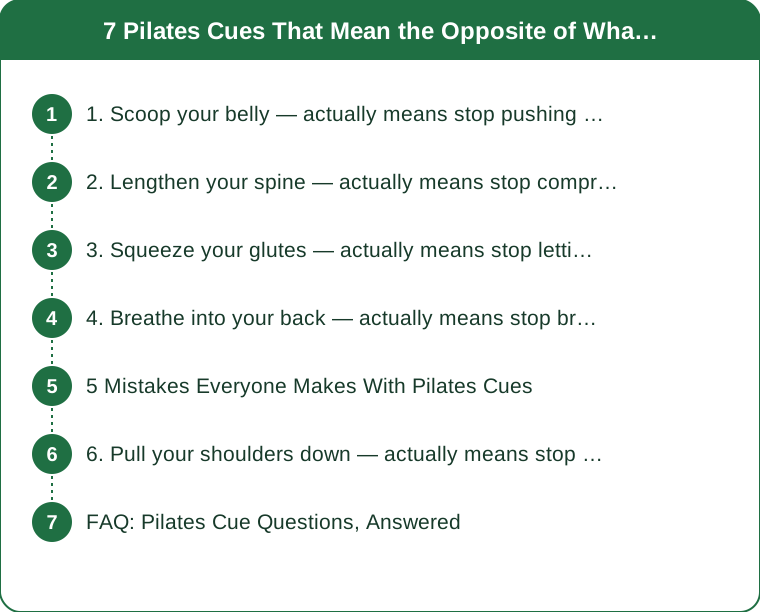
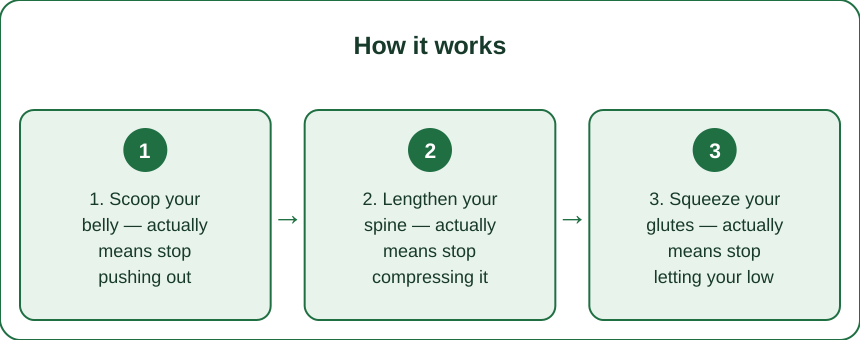
1. Scoop your belly — actually means stop pushing out
The literal interpretation is to suck the stomach inward and hold it there. What it’s pointing at is much smaller: the deep abdominal wall drawing in gently so the belly doesn’t dome outward under load.
Sucking in hard usually recruits the wrong layer and locks your breathing at the same time. If you can’t talk during the exercise, you’ve over-scooped. The correct version is closer to about 30% effort — noticeable to you, invisible to anyone watching.
2. Lengthen your spine — actually means stop compressing it
Nobody’s spine gets meaningfully longer during a mat class. The cue exists because most people shorten their spine under effort, jamming the ribs down toward the hips.
Translated: create space between each vertebra by not crunching down. In practice that means the top of your head reaches away from your tailbone rather than any active stretching. If you feel a pull anywhere, you’ve turned a stability cue into a stretch.
3. Squeeze your glutes — actually means stop letting your low back do it
In bridging and extension work, this cue exists almost entirely to prevent lumbar takeover. Literally squeezing as hard as you can tips the pelvis into a hard tuck and often kills the hamstring involvement entirely.
A useful test: at the top of a bridge, can you lift one foot slightly without your hips dropping or shifting? If yes, your glutes are doing the work at the right intensity. If no, more squeezing won’t fix it — better positioning will.

4. Breathe into your back — actually means stop breathing into your neck
Air doesn’t go into your back. What the cue is trying to change is where your ribcage expands: laterally and posteriorly rather than straight up toward your shoulders.
Hands on the sides of your lower ribs, 5 slow breaths, feeling the ribs widen sideways into your palms — that’s the whole skill. Once you can do it lying down, the cue starts making sense standing up, which is where it actually matters.
5 Mistakes Everyone Makes With Pilates Cues
Mistake 1: assuming a cue is universal. Instructors cue toward the average error in the room. If your error is the opposite one, the cue makes you worse, not better.
Mistake 2: holding a cue for the entire exercise. Most cues apply at a specific moment — the initiation, the top, the transition — not for all 10 reps continuously.
Mistake 3: adding effort when a cue doesn’t land. Nearly every cue that fails is failing because of too much tension, not too little.
Mistake 4: chasing the sensation instead of the movement. Feeling something isn’t proof you did it right; it’s proof something got loaded.
Mistake 5: never asking. The third one on this list surprises even experienced students — instructors are usually delighted to translate a cue if you ask after class.
6. Pull your shoulders down — actually means stop shrugging under load
Held literally and continuously, this cue pins the shoulder blades down and blocks the upward rotation your shoulders need in overhead work. Depression isn’t a resting state; it’s a correction to an error.
The useful version is momentary: as effort begins, don’t let the shoulders migrate toward your ears. Once you’re moving, let the shoulder blade glide. Locked shoulder blades in a plank are one of the most common reasons people feel a plank in their neck.
A quick self-check: hold a plank for 20 seconds and see whether you can still take a full breath into the sides of your ribs. If your ribcage feels welded in place, the shoulder cue has been over-applied and the whole position has become a bracing exercise instead of a control one.
7. Neutral spine — actually means your neutral, not the diagram’s
Neutral spine gets taught as a fixed anatomical position, usually illustrated with a tidy side-view diagram. In practice, neutral varies meaningfully between people based on pelvic structure, hamstring length, and history — your neutral is the position where your ribs stack over your pelvis without effort, not a specific number of degrees.
The way to find it takes about 15 seconds. Lying on your back with knees bent, tilt the pelvis fully one way, then fully the other, then settle somewhere in the middle where the effort drops off. That middle spot — usually with a small, natural gap under the low back — is your neutral, and it’s the reference point every other cue in class is quietly assuming you’ve already located.
This one matters more than its ranking suggests, because a misplaced neutral makes every subsequent cue land wrong. If scoop, lengthen, and shoulders-down have all felt vague, start here rather than working through them individually.
FAQ: Pilates Cue Questions, Answered
If cues are metaphors, why not just say the anatomical version?
Because anatomical instructions rarely change how a movement feels in real time. A metaphor produces an immediate sensory adjustment; an anatomy lecture usually doesn’t.
Is it a problem that different instructors cue the same exercise differently?
No — it usually means they’re correcting different common errors, or teaching a different Pilates lineage. Pick the version that produces the intended movement in your body.
How do I know if I’m interpreting a cue correctly?
The honest test is whether you can breathe normally and control the return phase at the same tempo as the effort phase. Almost every misread cue breaks one of those two.
TL;DR:
- Classic Pilates cues are sensory metaphors, not literal anatomical instructions
- Most cue failures come from too much tension, not too little
- Cues target the average error in the room — if yours is the opposite, the cue backfires
- The breathing-and-tempo test catches nearly every misinterpretation
Once you start hearing cues as translations rather than commands, the exercises that never quite worked tend to start working within a few sessions. Ask your instructor what a cue is trying to prevent — the answer is usually more useful than the cue itself.
See It in Motion
Seen here: High Waist Yoga Leggings with Side Pockets — shop it on bubblelime.com
Keep Reading
This article is for general informational and styling purposes only. Fit, sizing, and product availability may vary.