7 Pilates Cues That Mean Something Completely Different Than You Think
Quick Answer: Pilates cues are shorthand for sensations, not instructions for muscles. Several of the most repeated ones — navel to spine, tuck your tailbone, engage your core, lengthen through the crown — were designed to produce a feeling, and taken literally they produce breath-holding, over-gripping, pelvic tucking and neck tension. Here are the seven that most commonly go wrong, what each is actually asking for, and what to do instead.
Nobody explains that they are metaphors. Everybody assumes everybody else knows.
Here is what each of them is actually trying to get you to do.
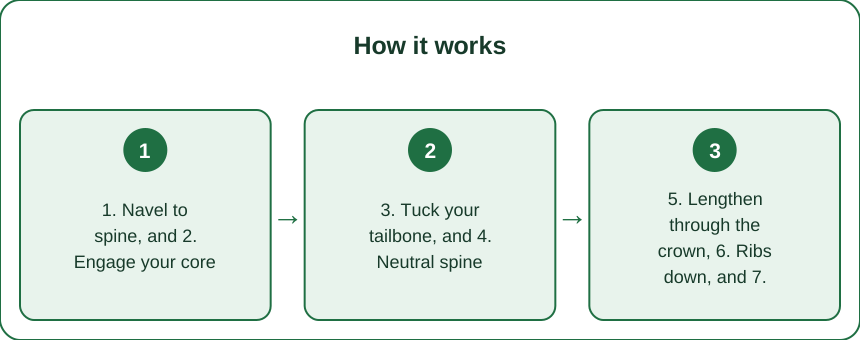
1. Navel to spine, and 2. Engage your core
Cue one: pull your navel to your spine.
What people do: suck the stomach in hard, hold it, and stop breathing properly. The abdomen becomes rigid and the ribs stop moving.
What it means: a gentle drawing in of the deep abdominal wall, roughly 20 to 30 percent of your maximum effort, that you can maintain while breathing normally and talking. It is about connection and support, not compression.
The test: if you cannot hold a conversation while doing it, you are doing far too much. Maximum abdominal bracing is a legitimate technique for heavy lifting and it is not what Pilates is asking for.
Why it matters: over-gripping the abdominal wall increases intra-abdominal pressure, which pushes down on the pelvic floor and up against the diaphragm. It restricts breathing and it can make pelvic floor symptoms worse rather than better — the opposite of the intended effect.
Cue two: engage your core.
What people do: tighten the outermost abdominal muscles, the ones you can see.
What it means: coordinate the deep system — the transverse abdominis, the pelvic floor, the diaphragm and the deep spinal muscles — which work together as a pressure-managing unit. This is much subtler than tensing.
The cue that works better: exhale gently and feel the sensation just above your pubic bone tighten slightly. That is the feeling. Everything above and around it should stay soft enough to move.
3. Tuck your tailbone, and 4. Neutral spine
Cue three: tuck your tailbone.
What people do: flatten the lower back into the mat hard, gripping the glutes and hamstrings.
What it means: usually the instructor is correcting an excessive arch in a specific person and using shorthand. It is a correction, not a universal position.
Why it matters: a permanently tucked pelvis flattens the lumbar curve, which is a load-bearing structure. Holding it flattened under load transfers stress to the discs and to the lower back musculature, and it also switches off the glutes at exactly the moment several exercises need them.
If you are cued to tuck and it produces gripping in your buttocks or your hamstrings, ask what the instructor is looking for. In a good class this question is welcome.
Cue four: find your neutral spine.
What people do: guess, or adopt whatever feels normal, which is frequently their habitual posture rather than neutral.
What it means: the position where the natural curves of the spine are present — a small lumbar curve, not flattened and not exaggerated. Lying on your back, there should be a small gap under your lower back, roughly enough for a flat hand, though this varies by individual.
The practical way to find it: lie down, tilt the pelvis fully one way then fully the other, several times, getting smaller each time until you settle in the middle. The midpoint is neutral, and finding it by movement is far more reliable than trying to arrive at it directly.
And worth knowing: neutral is not the right position for every exercise. Many Pilates exercises are deliberately performed in flexion, and imprint — a slight posterior tilt — is a legitimate position used intentionally in some contexts.
5. Lengthen through the crown, 6. Ribs down, and 7. Breathe into your back
Cue five: lengthen through the crown of your head.
What people do: lift the chin and jut the head forward, or tense the neck and shoulders to create a feeling of height.
What it means: create space through the whole spine by gently drawing the back of the skull upward, with the chin slightly tucked and the throat soft. The sensation should be of the head floating, not being pushed.
The correction that helps: think about the point where your skull meets your neck, at the very back, rather than the top of your head. That single change fixes it for most people.
Cue six: keep your ribs down.
What people do: jam the ribcage down forcefully, which rounds the upper back and restricts breathing entirely.
What it means: prevent the flaring of the lower ribs that happens when the abdominal wall disconnects — usually when arms go overhead or the back arches. It is about the ribs staying connected to the pelvis, not about pressing them anywhere.
Better version: exhale, and let the ribs settle. Breath does it; muscle does not.
Cue seven: breathe into your back, or into your ribs.
What people do: get confused, because you obviously cannot breathe into your back.
What it means: lateral or posterior ribcage expansion. Most people breathe by expanding the front of the abdomen only. Pilates emphasises expanding the ribcage sideways and backwards, which allows fuller diaphragm movement while the abdominal connection is maintained.
How to feel it: wrap your hands around your lower ribs and try to push your hands outward with the inhale. Once you have felt it, the cue makes sense permanently.
Why do instructors use metaphors at all?
Because the alternative is worse, and this is worth understanding rather than resenting.
The muscles involved are largely invisible and not consciously controllable in isolation. You cannot decide to contract your transverse abdominis the way you can decide to bend your elbow. Deep stabilising muscles respond to task demands and to intention, not to direct instruction.
So cues aim at the sensation instead, because the sensation is what you can actually notice and reproduce.
Anatomical accuracy would not help most people. A cue that named the correct muscles would be less effective for the majority of a class than an imperfect metaphor that produces the right feeling.
And cues are often individual. An instructor scanning a room sees one person over-arching and one person over-tucking and may give a cue aimed at one of them. Not every cue in a class is for you, which is a genuinely liberating thing to know.
What to do with this:
- Ask what a cue is meant to feel like, rather than what it means. Good instructors answer this well and it is the most useful question in the room.
- Notice whether a cue makes you hold your breath. That is the universal signal that you have taken it too literally.
- Prefer less effort than more. Almost every one of these cues goes wrong through overdoing it, and almost none through underdoing it.
Is it worth doing a private session?
One or two private sessions do more for cue interpretation than months of classes, because the instructor can see and correct your specific version. It is the highest-value spend in the whole discipline for most people.
Is there anything about this time of year worth knowing?
A few things, as studios fill up in September.
Autumn is the busiest intake of the year, which means larger classes and less individual correction. In a busy class, cues get more generic and the risk of misinterpreting them goes up. If you are new, this is the season to consider a beginners’ course rather than dropping into a general class.
Cold studios change what your body will do. Early morning classes in autumn start with colder, stiffer tissue, and the cues that assume a warm body — particularly anything about lengthening or reaching — produce more force to achieve the same range. Arrive earlier and move before class, rather than relying on the first five minutes.
Layers affect the instructor’s ability to see you. Loose autumn clothing hides exactly the pelvic and ribcage positions the instructor is watching. Fitted layers matter for feedback, not for appearance, and a top that stays put is the single most useful item.
And people return after a summer break, expecting their previous level. Range and control both decline over several weeks off, and the first few classes back are the most common place for niggles to appear. Go back at 70 percent for two or three sessions.
This is general information, not medical advice. Tell your instructor about any injury or condition, and see a professional for persistent pain.
FAQ: Pilates Cue Questions, Answered
Should my stomach be flat during Pilates?
No. The abdominal wall should be connected and able to move with breath. A rigidly held flat stomach usually means breath-holding.
Why does my neck hurt during ab exercises?
Usually the head is being lifted by the neck rather than supported by the upper abdominals. Support your head with a hand, or reduce the range, until the connection is established.
Is it normal to shake?
Yes, particularly in small stabilising muscles that are unaccustomed to sustained work. Shaking that comes with pain is a different matter.
How often should I go?
Twice a week is the common recommendation for noticeable change. Once a week maintains; three times accelerates.
Do I need reformer classes?
No. Mat work is a complete discipline. The reformer offers spring resistance and support that some people find helpful, and it is an addition rather than an upgrade.
What if a cue does not make sense to me?
Ask. Instructors generally welcome it, and if a cue is not landing after two attempts, it is the wrong cue for you rather than a failure on your part.
TL;DR:
- Pilates cues are metaphors for sensations, not muscle instructions — taken literally they cause the problems they were meant to prevent.
- Navel to spine means about 20 to 30 percent effort you can breathe and talk through, not maximum bracing.
- Tuck your tailbone is usually a correction for one person, not a universal position.
- Neutral spine is found by rocking the pelvis and settling in the middle, not by guessing.
- Lengthen through the crown works better as think about the back of the skull.
- Ribs down is achieved by exhaling, not by pressing.
- Breathe into your back means lateral ribcage expansion — feel it with your hands on your lower ribs.
- If a cue makes you hold your breath, you have overdone it. That is the universal test.
The cues are not wrong. They were written as descriptions of a feeling, and somewhere along the way everyone started following them as instructions.
See It in Motion
Seen here: Racerback Tank Top - White — shop similar styles on bubblelime.com
Keep Reading
This article is for general informational and styling purposes only. Fit, sizing, and product availability may vary.