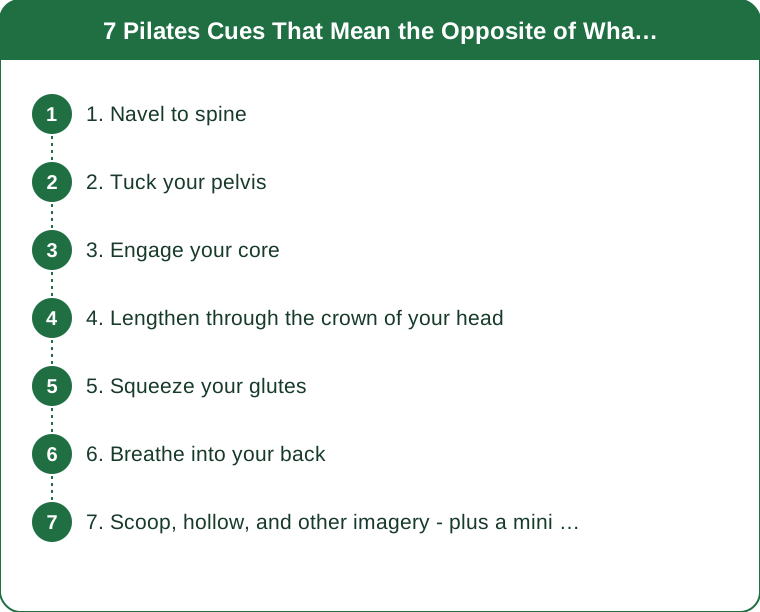
7 Pilates Cues That Mean the Opposite of What Most People Hear
Quick Answer: Most Pilates cues are metaphors that were never meant to be taken literally, and the literal reading usually produces the opposite of the intended effect. Navel to spine does not mean suck in hard; tuck your pelvis is a temporary correction rather than a position; and engage your core does not mean brace as if for impact. The fix in almost every case is to aim for about 30 percent effort and to keep breathing, because if you cannot talk, you have overdone it.
You can do a class for a year, follow every cue precisely, and be working against the exercise the whole time.
That is not a failure of effort. It is a translation problem, and here are the seven worst offenders.
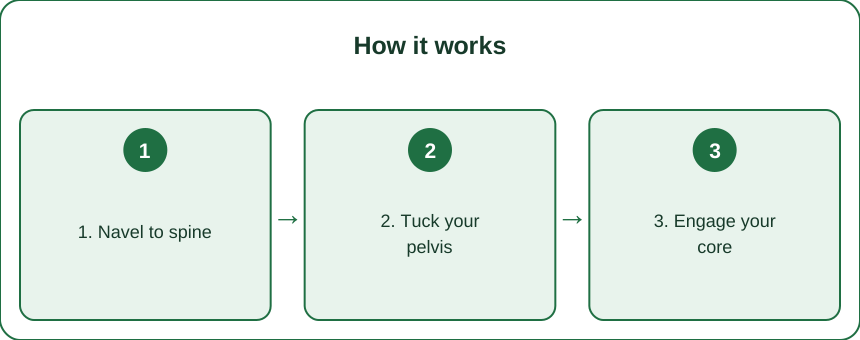
1. Navel to spine
What people hear: suck your stomach in as hard as you can. What follows is a rigid abdominal wall, held breath, and a rib cage that flares upward because the air has to go somewhere.
What it means: a gentle drawing-in of the deep abdominal wall, roughly 30 percent of maximum, sustained while you continue to breathe normally. It is a stabilising cue, not a strength cue.
The test is speech. If you cannot hold a conversational sentence while doing it, you are at 80 percent rather than 30 and the deep stabilisers have been overridden by the superficial ones.
Maximum bracing actually reduces spinal control in most contexts, because it locks out the small adjustments that stability depends on. Stability is responsive, not rigid.
Try this instead: exhale gently, feel the waist narrow slightly without the ribs moving, then keep breathing into the back and sides of the rib cage while holding that mild narrowing. That is the sensation the cue was pointing at all along.
2. Tuck your pelvis
What people hear: hold a posterior pelvic tilt for the entire class. What follows is a flattened lumbar spine, a gripping glute, and hip flexors doing work that belongs elsewhere.
What it means: a temporary correction for people who arrive in significant anterior tilt, used to find neutral, not a destination to camp in.
Neutral pelvis is the working position for most Pilates work, with the hip bones and pubic bone roughly level in the horizontal plane when lying on your back.
Chronic tucking has costs. It reduces the lumbar curve that spreads load through the spine, and it recruits the glutes into a stabilising role that leaves them unavailable for the movement itself.
Try this instead: find the two ends - tuck fully, arch fully - and settle in the middle. That middle is neutral, and most exercises want it.
3. Engage your core
What people hear: tense everything from ribs to hips. It is the vaguest cue in fitness and the one most likely to produce breath-holding.
What it means: the deep system - transversus abdominis, pelvic floor, diaphragm and multifidus - working together at a low, sustained level. These are endurance muscles, and endurance muscles do not do maximum contractions.
The pelvic floor is part of the system and is usually left out of the cue, which is why so many people brace hard with the abdominals while the floor does nothing or, worse, bears down.
Breathing is the tell. A properly engaged deep system allows full, quiet breathing. If your breath goes shallow or stops, the superficial muscles have taken over.
Try this instead: think of a gentle lift from underneath rather than a squeeze from the front, and check that you can still count to ten out loud.
4. Lengthen through the crown of your head
What people hear: lift the chin and stretch the neck upward. What follows is cervical extension, a jutting chin and a tight upper trapezius.
What it means: length through the whole spine with the head balanced on top, chin very slightly down, back of the neck long.
The intention is decompression rather than elevation. Nothing should be straining upward; the sensation is closer to being gently taller than to reaching.
Shoulder position matters here - if the shoulders rise with the cue, you have recruited the wrong muscles entirely.
Try this instead: imagine the ceiling is one inch above your head and you are trying to almost touch it, with the back of the neck long. Nearly everyone gets it on the first attempt with that phrasing.
5. Squeeze your glutes
What people hear: maximum clench, held throughout. In bridging work particularly, this is the cue that turns a hip extension exercise into a hamstring cramp.
What it means: purposeful glute activation timed to the movement, typically at the top of a bridge, released as you lower.
Constant clenching produces posterior tilt - see cue number two - which flattens the lumbar spine and takes the hip out of the range the exercise was designed to train.
Cramping hamstrings are the classic diagnostic. If your hamstrings cramp in bridges, the glutes are not doing their share and the timing is usually the reason.
Try this instead: squeeze at the top, hold for two counts, and let go completely on the way down. Contraction and release is the pattern, not permanent tension.
6. Breathe into your back
What people hear: an instruction that is anatomically impossible, so it gets ignored. Air goes into lungs, and lungs are at the front - or so the mental model goes.
What it means: lateral and posterior rib cage expansion, which is entirely real. The lungs extend well back and the lower ribs move outward and backward on inhalation when the abdominal wall is gently engaged.
This is exactly what makes Pilates breathing feel backwards at first. You hold the abdominal wall lightly, so the breath has to go somewhere else - and sideways and back is where.
It matters because it lets you keep the deep system engaged while still breathing fully, which is the mechanical problem the whole breathing pattern exists to solve.
Try this instead: wrap your hands around your lower ribs, thumbs toward the back, and try to push your hands apart on the inhale without your belly moving forward. That is the pattern.
7. Scoop, hollow, and other imagery - plus a mini FAQ
What people hear: another instruction to suck in. Scoop, hollow, zip up, imprint - the vocabulary multiplies and all of it lands on the same overworked interpretation.
What it means: these are all pointing at the same 30 percent deep engagement from different angles, because different images work for different bodies. They are not seven separate actions.
Try this instead: pick the one image that works for you and ignore the rest. A cue you understand beats five you are approximating.
Should I ask my instructor what a cue means?
Yes, and good instructors welcome it. Cues are shorthand that assumes shared context, and asking is how the context gets built. Ask after class if asking mid-exercise feels awkward.
How do I know if I am engaging too hard?
Try to say a full sentence out loud. If you cannot, or if your breath has gone shallow and high, you are past the useful level. Aim for roughly 30 percent of maximum.
Why do different instructors use contradictory cues?
Because the traditions differ and because cues are corrective - an instructor who says tuck is usually correcting a specific person’s excess arch, not describing a universal rule. Take cues as feedback to you rather than as doctrine.
TL;DR:
- Nearly every over-effort problem in Pilates comes from taking a metaphorical cue literally.
- Navel to spine means about 30 percent engagement while still breathing, not maximum bracing.
- Tuck the pelvis is a temporary correction toward neutral, not a position to hold all class.
- Squeeze the glutes means timed contraction and release, which is why cramping hamstrings signal bad timing.
- Breathing into the back is real - the lower ribs expand sideways and backward, and that is what makes the pattern feel odd at first.
- The universal check: if you cannot say a sentence out loud, you have overdone it.
Ask your instructor what a cue means for your body specifically. Cues are corrections aimed at individuals, not universal rules. This is general information, not medical advice.
See It in Motion
Seen here: Racerback Tank Top - White — shop similar styles on bubblelime.com
Keep Reading
This article is for general informational and styling purposes only. Fit, sizing, and product availability may vary.