7 Reasons Your Pilates Side-Lying Work Feels Lopsided
Quick Answer: Side-lying work feels uneven for seven common reasons, and only one of them is actual strength difference. The usual culprits are setup drift (your body rotates a few degrees between sides), unequal shoulder support, a different head position, breathing that changes side to side, doing the second side when you are already fatigued, hip stacking that is not actually stacked, and the fact that your first side gets a rehearsal the second side never does. Fix setup before you conclude anything about strength.
You get through the first side. It burns, but it works.
You roll over, set up on the second side, and something is wrong. Either it is dramatically harder, or it barely registers, and neither one feels like the same exercise you just did.
Almost everyone assumes this means one side is weaker. Sometimes it does. Much more often the two sides are not doing the same exercise — and the differences are small enough that nobody sees them, including your instructor from across the room.
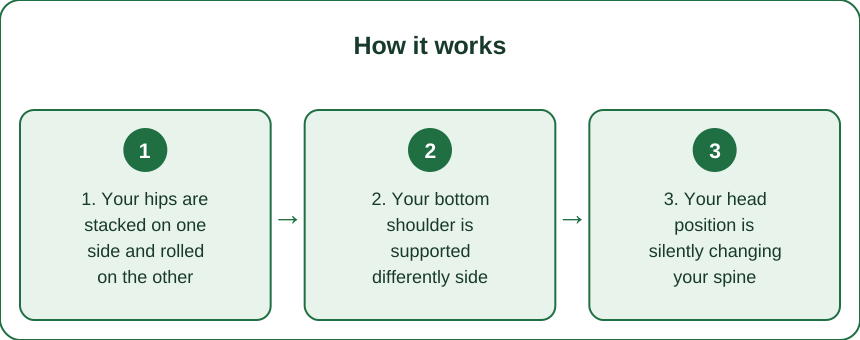
1. Your hips are stacked on one side and rolled on the other
This is the biggest single cause and the hardest one to feel.
Side-lying leg work depends entirely on the pelvis staying square — the top hip directly above the bottom hip, both facing the wall in front of you. Roll the top hip back even 10 degrees and the exercise changes target completely: the work shifts from the outer hip toward the hip flexors and the front of the thigh.
Why it happens more on one side: most people have a habitual rotation preference from how they sit, sleep, and stand. Lying on your less-familiar side, the pelvis quietly rolls back to find the position it prefers.
The check that actually works: set up with your back against a wall. Heels, hips, and shoulder blades all touching it. If you have to peel your top hip off the wall to lift the leg, you were rotating.
What it feels like when corrected: significantly harder, and much more concentrated in the side of the hip rather than the front. Most people find the range of motion drops by a third. That is not a loss — the earlier range was borrowed from rotation.
2. Your bottom shoulder is supported differently side to side
Look at what your bottom arm is doing on each side. Most people do not do the same thing twice.
Common variations, all of which change the exercise:
- Head resting on an extended bottom arm — long spine, but the shoulder takes load and the neck can side-bend if the arm is not thick enough to fill the gap.
- Head on a cushion or block, arm folded — neutral neck, no shoulder load, most stable.
- Propped up on the forearm — this one changes everything, because it side-bends the spine and shortens the top side, which alters what the hip can do.
If you prop on one side and lie flat on the other, the two sides are not comparable. The propped side loads the obliques and puts the hip in a different starting angle.
Pick one and use it both sides. For most people the most repeatable is head on a small cushion, bottom arm folded in front for balance. It removes the shoulder and neck from the equation so the hip is doing the reporting.
3. Your head position is silently changing your spine
The neck is the top of the same chain, and it does not stay neutral by itself.
Lying on your side, gravity pulls your head toward the mat. Without support, the neck side-bends downward. That side-bend travels — the ribs follow, the waist shortens on the bottom side, and the pelvis tips slightly.
Now do the other side with a slightly different amount of support and you have two different spinal shapes doing what is supposed to be one exercise.
The fix is embarrassingly simple: the gap between your head and the mat should be filled so your head sits in line with your spine. For most people that is one folded towel or a small cushion — often more than they think.
How to know you had it wrong: if the second side suddenly feels the same as the first once you match the support, the difference was never in your hips.
4. The second side inherits the fatigue from the first
Nobody controls for this, and it accounts for a real part of the gap.
By the time you start side two, you have already done a full set of side one. Your deep hip stabilisers on both sides were working during side one — the bottom leg and the trunk work hard to stabilise even though they are not the star of the exercise.
So side two starts pre-fatigued. If you always start on the same side, that side gets the fresh version every single session, permanently.
Two ways to test whether this is your issue:
- Alternate which side you start on for two weeks. If the gap follows the starting order rather than the body, fatigue was a major part of it.
- Do one exercise on both sides before moving to the next, rather than the whole series on one side then the whole series on the other. The gap usually shrinks.
Instructors often teach the full series per side because it flows better in a class. It is fine — just know that it builds an order effect into everything you feel.
5. Your breathing pattern is not the same on both sides
This one surprises people, and it is measurable.
Lying on your side compresses the bottom ribs. The bottom lung has less room and the top side does more of the breathing. Since almost everyone has a habitual rib position that is slightly asymmetric to begin with, the compression is not equal side to side.
Why it matters for the exercise: in Pilates, breath is part of trunk stabilisation. If you can expand your ribs well on one side and are restricted on the other, the trunk stability underneath the leg work is different.
What it feels like: the harder side often comes with a subtle sense of holding your breath, or of the exhale running out early.
The intervention: before starting each side, take three slow breaths aimed at the top-side ribs, letting them widen laterally. Then start. It costs ten seconds and it evens out the platform your leg is working from.
6. What Nobody Tells You: your first side gets a rehearsal
Here is the effect nobody mentions, and once you see it you cannot unsee it.
When you do side one, you are figuring out the movement. Where the leg goes, how high, how fast, where it starts to feel wrong. Your nervous system is problem-solving in real time, and part of the burn on side one is inefficiency — extra muscles joining in because the pattern is not clean yet.
By side two you have just watched yourself do it. The pattern is fresher, the coordination is better, and you execute more efficiently. More efficient often feels easier, even at identical strength.
So a side that feels easier may simply be the side that had the benefit of a rehearsal.
How to separate the two: count. Do not judge by feel — count how many controlled reps each side manages before form degrades. If both sides give you the same number with the same quality, the difference was rehearsal and sensation, not capacity.
The corollary: if you always start with your right, your left will feel more coordinated and your right will feel like it works harder. That is exactly backwards from what most people conclude.
7. FAQ: Side-Lying Pilates Questions, Answered
Is a real strength difference between sides normal?
Some side-to-side difference is normal in almost everyone, driven by handedness, sport history, and daily habits. What matters is whether the gap is stable and whether either side has pain. A modest difference that stays consistent is unremarkable; a gap that is growing, or one that comes with pain in the hip or low back, is worth having looked at by a physio or qualified professional.
Should I do extra reps on the weaker side?
Adding a small amount to the weaker side is reasonable — a few extra controlled reps, not double. But do it after you have ruled out the setup causes above, because most apparent weakness is positioning. If you add volume to a side that is actually just badly set up, you reinforce the compensation.
How long before an uneven side evens out?
If the cause was setup, it changes in one session — the moment you match the positions, the sides feel closer. If there is a genuine strength difference, expect it to narrow gradually over several weeks of consistent work rather than to disappear. Progress here shows up as the weaker side holding form for more reps, not as the burn going away.
TL;DR:
- Six of the seven causes are setup, not strength — hip stacking, shoulder support, head position, fatigue order, breathing, and the rehearsal effect.
- Match your setup exactly between sides before you draw any conclusion: same head support, same bottom arm, hips genuinely stacked.
- Alternate your starting side for a couple of weeks — if the gap follows the order instead of the body, it was fatigue.
- Count reps to form failure rather than judging by burn. Sensation is the least reliable measure you have here.
Side-lying work is the most honest position in Pilates precisely because it removes the floor’s help and exposes what the hip can actually do. That honesty cuts both ways — it also exposes every small inconsistency in how you set up. Fix the setup first, and most of the lopsidedness turns out to have been an illusion.
See It in Motion
Seen here: Super High Waist Embossed Yoga Leggings with Inner Pocket — shop it on bubblelime.com
Keep Reading
This article is for general informational and styling purposes only. Fit, sizing, and product availability may vary.