7 Pilates Roll-Up Mistakes That Keep You Stuck at the Bottom of the Mat
Quick Answer: Most roll-up struggles come down to one of seven fixable habits — moving from the neck instead of the abs, skipping the pelvic tilt, or rushing the sequence before the deep core is actually ready to control it. None of them mean you’re ‘bad at pilates’ — they’re timing and sequencing issues that show up in almost every beginner’s first few months.
You lie back, reach your arms overhead, and try to roll up smoothly — instead you jerk, stall halfway, or use your hands as a launchpad off the mat. That’s not a strength problem yet. It’s usually one of these seven things.

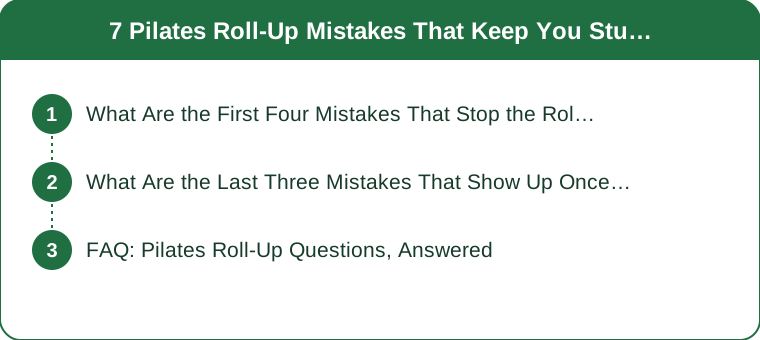
What Are the First Four Mistakes That Stop the Roll-Up Before It Even Starts?
1. Leading with the head and neck
Most people initiate the roll-up by yanking the chin toward the chest and craning the neck forward before the abs have engaged at all. The movement should start from a pelvic tilt and deep abdominal contraction, with the head following as a natural consequence, not the trigger. If your neck feels strained afterward, this is almost always the cause, and it’s worth pausing to reset rather than pushing through more reps with the same pattern. A useful cue instructors often give is to imagine the crown of the head reaching long across the room rather than curling down toward the knees, which naturally keeps the neck out of the driver’s seat.
2. Skipping the pelvic tilt entirely
The roll-up doesn’t start with the arms reaching forward — it starts with tilting the pelvis to flatten the low back into the mat, which pre-loads the deep abdominals before any lifting happens. Skip this step and you’re asking your hip flexors to do a job your core hasn’t set up yet, which is exactly why the movement feels like a fight from the first inch. Practicing the pelvic tilt on its own, disconnected from the rest of the roll-up, for even thirty seconds before attempting the full movement, tends to make this step far more automatic.
3. Using momentum instead of control
A fast, jerky swing up off the mat usually means the deep core isn’t yet strong enough to control the movement slowly, so momentum quietly compensates. A true roll-up should look the same speed rolling up as rolling down — if one direction is noticeably faster than the other, that’s a strength gap, not a technique preference, and it’s the single easiest thing to self-diagnose in a mirror. Filming yourself from the side occasionally is a simple way to actually see this asymmetry, since it’s harder to feel accurately in the moment than it is to spot on video.
4. Locking the knees too hard
Overly locked, braced knees pull tension up through the hamstrings and pelvis in a way that resists the smooth articulation the spine actually needs. A soft microbend in the knees allows the pelvis to tilt freely, which is required for the first two inches of the roll-up to happen correctly, and it’s a small adjustment that fixes a surprising amount of the ‘stuck at the bottom’ feeling. Many people brace their knees out of habit from other forms of exercise, so this one often takes a few conscious reminders before it becomes second nature.

What Are the Last Three Mistakes That Show Up Once You’re Already Moving?
5. Rushing through the middle ‘stuck’ point
Most people get through the first third and the last third fine, then stall in the middle where the torso is roughly vertical over the hips — this is the point of maximum resistance against gravity. Rushing through it with a jerk defeats the purpose; slowing down and breathing through that exact point builds the strength that’s actually missing, even though it feels like the least productive place to linger. Some instructors recommend deliberately pausing for one full breath right at that vertical midpoint as a standalone drill, since it forces the deep core to hold under tension instead of relying on momentum to blow past it.
6. Forgetting to exhale on the way up
Breath isn’t decorative in pilates — exhaling fully as you roll up helps engage the deep transverse abdominis, the muscle doing most of the stabilizing work through the hardest part of the range. Holding your breath or breathing shallowly removes a mechanical advantage you’d otherwise have for free, every single rep. Pairing the exhale specifically with the hardest section of the lift, rather than exhaling early and then holding, tends to make the connection between breath and effort click faster.
7. Reaching the arms too far forward, too soon
Stretching the arms way out in front before the torso has actually cleared the mat pulls the upper body forward with momentum instead of letting the spine articulate one vertebra at a time. Keeping the arms closer to the body until the torso is upright, then extending forward at the top, keeps the sequencing honest — and it usually looks smoother within a single practice session once you feel the difference. This one is easy to overlook because reaching forward feels productive, even though it’s quietly doing the opposite of what a controlled roll-up actually needs from the arms early on.
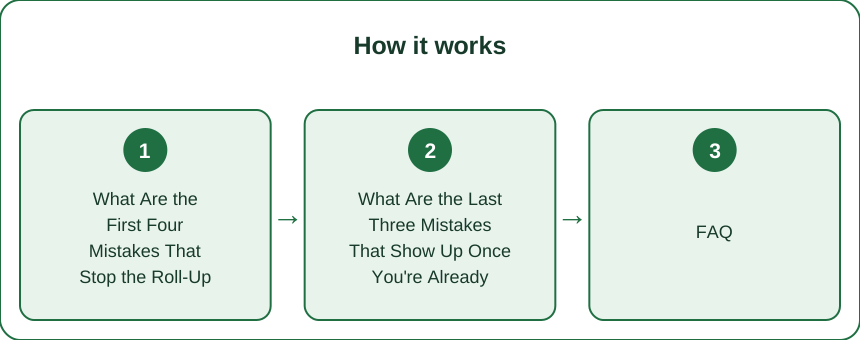
FAQ: Pilates Roll-Up Questions, Answered
Is it normal to not be able to do a full roll-up for months?
Yes — the roll-up is considered an intermediate-to-advanced pilates movement specifically because it requires a level of deep core control that takes consistent practice to build; most instructors expect it to take weeks to months, not days, and plenty of regular practitioners still work the modified, bent-knee version indefinitely without it being a sign of anything wrong.
Should you use your hands to push off the mat if you’re stuck?
It’s a reasonable modification while building strength, but it’s worth also practicing the unassisted version regularly with bent knees so you’re training the actual muscle recruitment pattern, not just working around it indefinitely — treat the hand-assist as a stepping stone rather than a permanent solution if progress is the goal.
Does practicing the roll-down first help more than starting with the roll-up?
Many instructors teach the roll-down before the roll-up specifically because it’s easier to control with gravity assisting rather than resisting, and it builds the same eccentric core control that eventually makes the roll-up itself possible — a few weeks of focused roll-down practice often makes the roll-up itself click noticeably faster than jumping straight to the harder direction.
TL;DR:
- Roll-up struggles almost always trace back to one of seven fixable habits, not general weakness
- The pelvic tilt and full exhale are the two most commonly skipped mechanical steps
- The ‘stuck’ middle point is where deep core strength is actually being built, not a sign of failure
- Momentum and hand-pushing are workarounds, not fixes — practice the slow, controlled version regularly
A smooth roll-up isn’t about being flexible or strong in general — it’s about sequencing seven small things correctly, and most people are only missing two or three of them.
See It in Motion
Seen here: High Waist Bootcut Yoga Pants — shop it on bubblelime.com
Keep Reading
This article is for general informational and styling purposes only. Fit, sizing, and product availability may vary.