Pilates for Better Posture: 6 Moves to Stop Slouching
Quick Answer: Pilates improves posture by strengthening the deep core and upper-back muscles that hold you upright, so standing tall stops taking effort. Six moves do most of the work: Chest Lift, Swan Prep, Bird Dog, Shoulder Bridge, Spine Stretch Forward, and Standing Roll-Down. Do them 3-4 times a week, 8-10 reps each, alongside a screen raised to eye level.
You catch your reflection in a shop window and there it is — shoulders rolled forward, head jutting, the whole upper body folded into a question mark.
You straighten up. Twenty minutes later you’re back to the question mark.
That’s the thing nobody tells you about posture: willpower has never once fixed it. Strength does. And Pilates happens to train exactly the muscles involved.

Why Is Pilates So Good for Posture?
Sitting up straight on command uses your conscious brain, and your conscious brain has other things to do — roughly every 90 seconds, apparently.
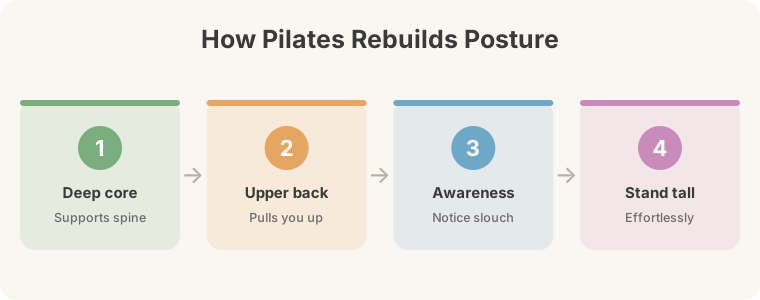
Good posture is what happens when the muscles that hold you upright are strong enough to do it without being asked. That’s a specific short list: the deep abdominals, the mid and upper back, the glutes, and the small stabilizers along the spine.
Pilates trains that exact list, and it adds a second thing that matters just as much — body awareness. Most desk workers genuinely can’t feel the difference between neutral and slouched anymore. Pilates rebuilds that signal, so your body starts correcting itself before you notice.
The third piece is mobility. Hours of sitting shorten the chest and hip flexors, which pull you forward no matter how strong your back is. Pilates opens both while it strengthens.
The 6 Posture-Fixing Pilates Moves
Move slowly. In every rep, think about lengthening through the crown of your head rather than yanking yourself into position. Aim for 8-10 controlled reps of each, 3-4 times a week.
1. Chest Lift
Lie on your back, knees bent, hands behind your head. Exhale and curl the head and shoulders off the mat, keeping the low back gently connected. This builds the abdominal strength that supports the spine from the front. 8-10 reps.
2. Swan Prep
Lie face down, hands under the shoulders. Lift your chest a few inches using your upper back — not by pushing with the arms. This is the direct antidote to the desk hunch, and it’s the one most people are weakest at. 8 slow reps.
3. Bird Dog
On all fours, extend the opposite arm and leg until they’re level with your torso. Hold 3-5 seconds. It trains the stabilizers to keep your spine aligned while your limbs move — which is what real life demands. 6-8 per side.
4. Shoulder Bridge
Feet hip-width, roll the spine up one vertebra at a time until you’re in a straight line from knee to shoulder, then roll down slowly. Strong glutes stop the pelvis tipping forward, which is where a lot of low-back slouch actually starts. 8-10 reps.
5. Spine Stretch Forward
Sit tall, legs extended, and roll forward one vertebra at a time as if peeling off a wall. Then stack back up the same way. This teaches spinal articulation and unwinds stiffness from sitting. 6 reps.
6. Standing Roll-Down
Stand, chin to chest, and roll down through the spine as far as is comfortable. Hang for two breaths, then rebuild upward. Perfect as a mid-afternoon reset at your desk. 4-5 reps.
What Nobody Tells You About Fixing Your Posture
It’s the front of your body that’s the problem. Everyone focuses on strengthening the back. But a tight chest and tight hip flexors pull you into a slouch that no amount of back strength can win against. You have to open the front while you strengthen the back.
Your screen height matters more than your chair. A laptop on a desk puts your screen roughly 12 inches below eye level, and your head follows your eyes. Raising the screen fixes more neck posture than any expensive chair.
Perfect posture isn’t the goal — movement is. Holding any single position for hours is the actual problem, including a textbook-perfect one. Changing position every 30-45 minutes beats sitting flawlessly still.
It takes about 6-8 weeks. Muscles adapt on a schedule, not on enthusiasm. Consistency at three sessions a week beats one heroic hour on Sunday.
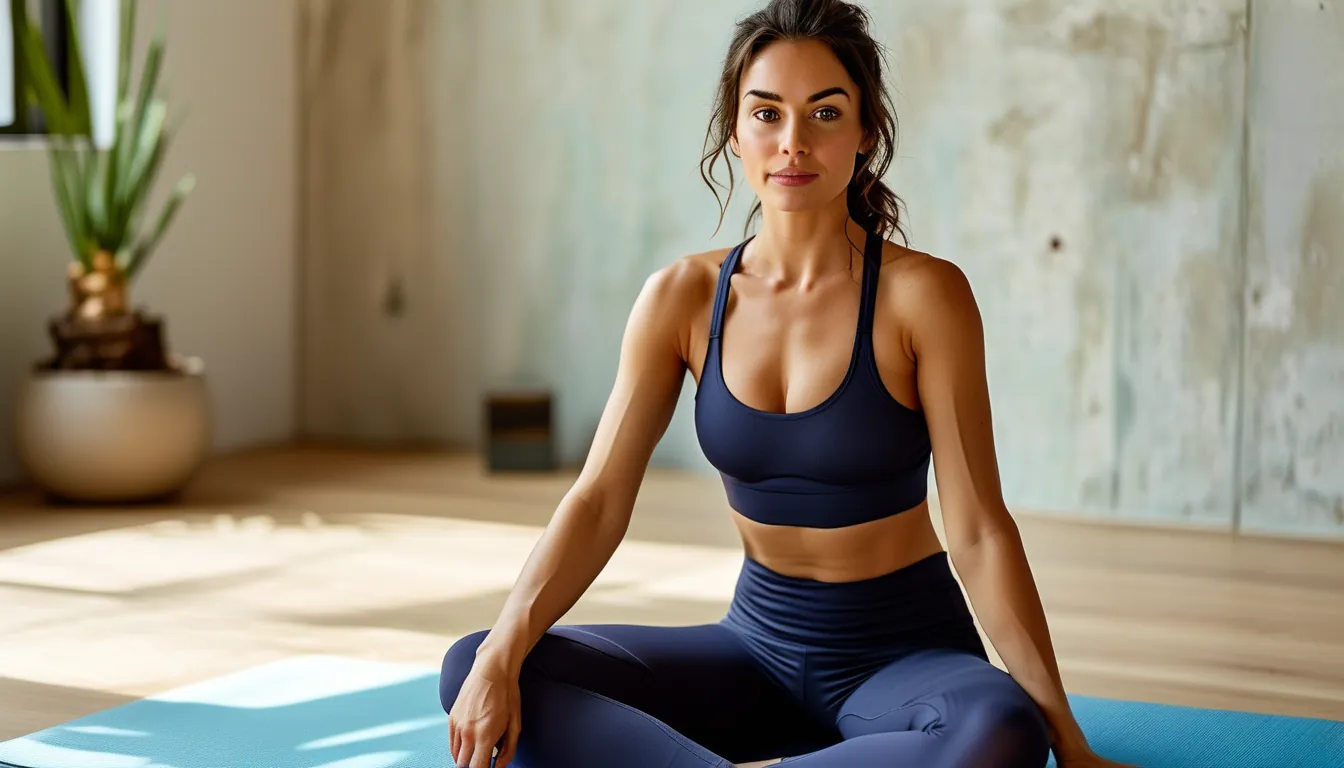
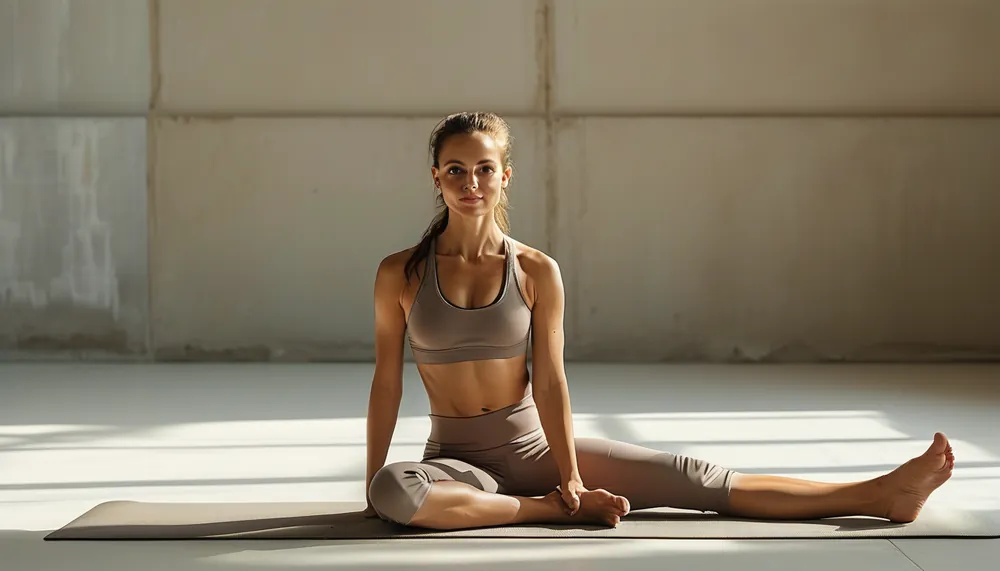
Comfortable clothing genuinely helps. It sounds minor, but if your waistband digs in when you hinge forward, you’ll unconsciously avoid the range of motion. A pair of high waist yoga pants that stay put through a roll-down means you actually complete the movement instead of half-doing it.
Small Habits That Do the Rest
- Movement breaks — stand and reset every 30-45 minutes, even for 20 seconds
- Screen at eye level — books, a stand, anything that stops the downward gaze
- Phone up, not head down — the “text neck” angle adds real load to the neck
- Sleep check — an overly thick pillow keeps the head pushed forward all night
- Notice, don’t nag — awareness is half of it, and it’s the half that’s free
Mini FAQ
How long does it take to improve posture with Pilates?
Most people notice they’re catching themselves slouching within 2-3 weeks — that’s the awareness piece arriving first. Visible, effortless change in how you stand usually takes 6-8 weeks of consistent practice at 3-4 sessions per week.
Can Pilates fix rounded shoulders?
It helps significantly, because rounded shoulders are usually a combination of a weak upper back and a tight chest, and Pilates addresses both. Swan Prep and Bird Dog are the two highest-value moves here. Long-standing structural changes may need a physical therapist’s input as well.
Is Pilates better than yoga for posture?
Both help. Pilates leans more toward targeted core and postural strengthening, while yoga leans more toward mobility and length. If your main issue is weakness and slouching, start with Pilates; if it’s stiffness, yoga may serve you faster. Doing some of each is the honest best answer.
TL;DR:
- Posture is a strength issue, not a willpower issue — reminders alone never hold.
- Six moves cover it: Chest Lift, Swan Prep, Bird Dog, Shoulder Bridge, Spine Stretch Forward, Standing Roll-Down.
- Do 8-10 controlled reps each, 3-4 times a week, and expect 6-8 weeks for real change.
- Open the front of the body (chest, hip flexors) as well as strengthening the back.
- Raise your screen to eye level and move every 30-45 minutes — the setup does half the work.
This article is for general wellness purposes only and isn’t medical advice. If you have persistent neck or back pain, numbness, or tingling, see a physical therapist or doctor before starting a new routine.
See It in Motion
Seen here: Super High Waist Embossed Yoga Leggings with Inner Pocket — shop it on bubblelime.com
Keep Reading
This article is for general informational and styling purposes only. Fit, sizing, and product availability may vary.