Mat Pilates at Home: Building a Real Practice Without the Studio Price Tag
Mat Pilates is the rare studio method that translates almost fully to a living room — the equipment is a mat and gravity, the curriculum is public, and the cost drops from boutique-membership to zero. The home-practice guide: the setup, the sessions and the path to self-practice.
The Setup
The minimal studio: the equipment truth (the mat being genuinely sufficient — the thicker pilates mat for spine-rolling comfort versus the thin yoga mat; the optional tier: the small ball, the light band, the magic circle for the committed), the space claim (the mat-plus-arms-reach footprint from the home-gym doctrine — the living-room corner sufficing; the same-spot consistency that builds the habit per the environment doctrine), the video infrastructure (the screen positioned for neck-neutral viewing — the laptop-on-chair setup; the audio-first classes for the practiced), the time-slot anchor (the 20-minute morning slot or the pre-dinner unwind — the habit-stacking placement from the routine doctrine; the frequency-over-duration law: the four 20-minute sessions beating the weekly hour), and the expectation calibration (the home practice building real strength-and-control — the reformer’s resistance features being different, not superior, for mat goals per the reformer-versus-mat doctrine).
The Session Structure
The beginner’s 25 minutes: the breath-and-alignment opener (the three minutes of pilates breathing from the breathing doctrine — the rib-cage lateral breath; the neutral-spine finding that calibrates everything after), the warm-up sequence (the pelvic tilts, the knee sways, the cat-cow articulation from the spine doctrine — the segmental wake-up), the core block (the hundred at beginner modification from the hundred doctrine — the dead bugs, the single-leg stretches, the shoulder-bridge series; the quality-over-reps law: the six precise reps beating twenty sloppy ones per the precision doctrine), the whole-body block (the side-lying leg series, the swimming preparation, the push-up progression — the pattern coverage beyond abs), the control challenge (the roll-up progression as the practice’s benchmark — the assisted versions honestly used; the rolling-like-a-ball for the playful), and the closing articulation (the spine stretch and the rest position — the two-minute downshift that bookends per the ritual doctrine).
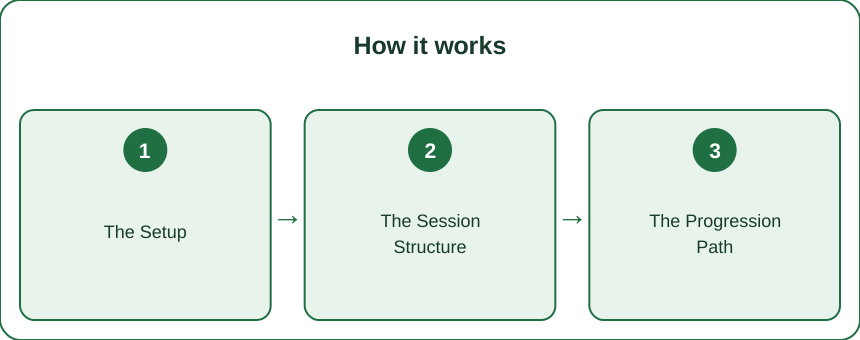
The Progression Path
From follower to practitioner: the video-era strategy (the single-teacher consistency for the first months — the cue vocabulary learned from one voice; the beginner-series completion before the buffet sampling per the curriculum doctrine), the level honesty (the modifications taken without apology — the bent-knee versions being the correct versions until they’re boring; the advancement earned per the progression doctrine), the self-practice bridge (the memorized 15-minute sequence as the first freedom — the video-free practice that deepens attention; the classical mat order as the traditional scaffold), the form self-audit (the phone-video check from the form doctrine — the neck-strain and momentum leaks caught; the mirror when available), the studio-sampling option (the occasional live class as the calibration visit — the teacher’s hands-on corrections imported back home; the hybrid economics: the weekly home practice with the monthly studio tune-up), the plateau answers (the small-equipment additions, the intermediate series, the tempo-and-hold intensifiers from the slow doctrine), and the practice close (the home mat as the daily-access advantage no studio offers — the ten-minute morning spine routine that studios can’t schedule; the practice owned outright, which was the point of the price tag escape). Mat down, one teacher, quality reps: the studio, relocated home.
A mat and one consistent teacher’s beginner series build a real practice — 25-minute sessions of breath, articulation and precise core work, four times weekly. Memorize a 15-minute sequence for video-free days and use a monthly studio class as a form tune-up.
See It in Motion
Seen here: High Waist Printed Bootcut Yoga Pants with Pockets — shop it on bubblelime.com
Keep Reading
This article is for general informational and styling purposes only. Fit, sizing, and product availability may vary.