7 Signs Your Pilates Form Has Quietly Gone Off Track
Quick Answer: The clearest signs your Pilates form has drifted are feeling exercises in your neck or lower back instead of your core, holding your breath through the hard parts, and moving faster than your control can keep up with — all fixable by slowing down and re-checking alignment.
Form doesn’t usually break all at once. It slips a few degrees at a time, session after session, until an exercise that used to feel like deep core work just feels like straining.

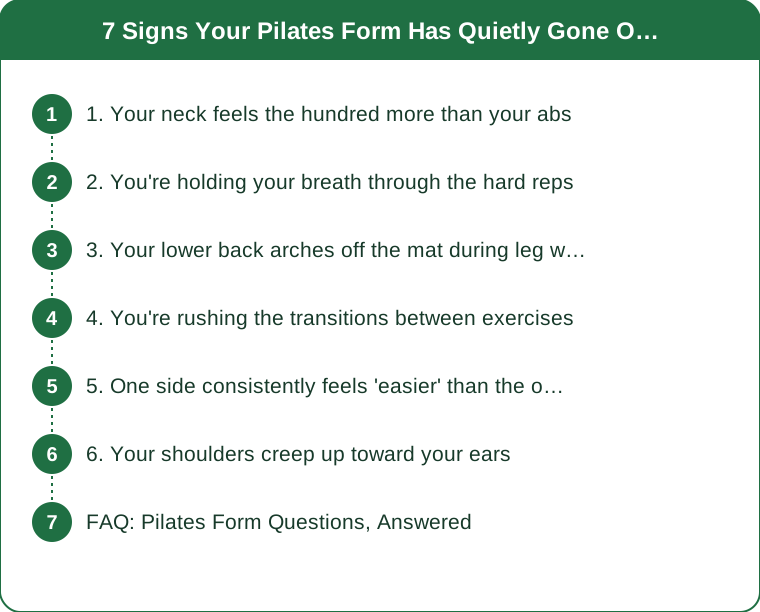
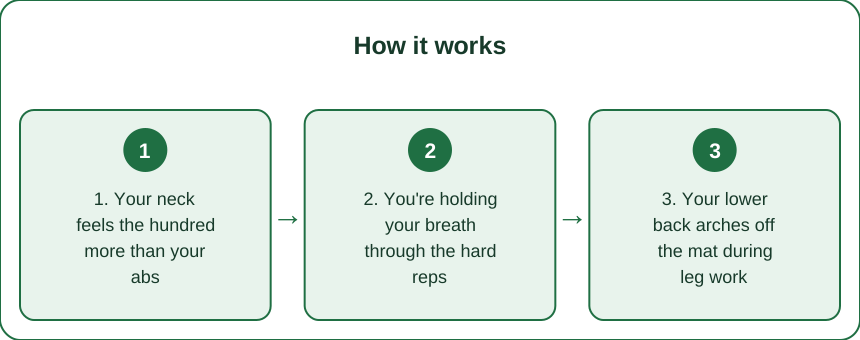
1. Your neck feels the hundred more than your abs
If the hundred leaves your neck sore the next day instead of your abs, your head is likely being pulled up by momentum rather than lifted by controlled curl. Cue: support the back of your head lightly with your hands for a few sets and focus on lifting from the breastbone.
2. You’re holding your breath through the hard reps
Breath-holding is one of the fastest ways form quietly degrades — it spikes intra-abdominal pressure in a way that masks weak core engagement instead of building it. Pilates breathing is meant to be continuous; if you notice silence during the toughest part of a set, that’s usually the first sign something’s off.
3. Your lower back arches off the mat during leg work
A small arch during leg circles or single-leg stretch means the deep core isn’t actually stabilizing the pelvis — the hip flexors are compensating instead. Bend the working knee slightly or reduce range of motion until the low back can stay flat without gripping.

4. You’re rushing the transitions between exercises
Pilates transitions are part of the workout, not a break between the real parts. Rushing them usually means momentum is starting to replace control everywhere else too — a useful check is whether you could pause mid-transition and hold it steady.
5. One side consistently feels ‘easier’ than the other
A persistent left-right difference usually means one side is compensating for the other’s weakness, not that one side is simply stronger. Slowing the weaker side down and adding a few extra controlled reps there tends to close the gap faster than ignoring it.
6. Your shoulders creep up toward your ears
Shoulder creep is a classic tension leak — it means effort is being generated from the wrong place, usually the neck and traps instead of the core and lats. Reset by rolling shoulders down and back before each new exercise, not just at the start of class.
Myth vs Fact: Myth — feeling the burn means you’re doing it right. Fact — a burning sensation in the wrong muscle (neck, hip flexors) is a sign of compensation, not progress. Myth — more reps fixes bad form. Fact — extra reps on a compensating pattern just reinforces it; fewer, cleaner reps beat more, sloppy ones every time.
FAQ: Pilates Form Questions, Answered
How often should form actually be checked?
Every few weeks, ideally with a mirror or a quick phone video — form drifts slowly enough that it’s hard to self-detect without an outside check.
Does an instructor correction mean the whole exercise was wrong?
Not at all — most corrections are small angle adjustments, not a sign the exercise itself was being done badly overall.
Is it normal for form to break down as fatigue sets in during a class?
Yes, to a degree, but it’s a signal to reduce reps or intensity rather than push through with degrading form, which just builds a compensation habit.
TL;DR:
- Neck soreness after the hundred usually means the head is being pulled, not curled
- Breath-holding during hard reps masks weak core engagement instead of building it
- A low-back arch during leg work signals the hip flexors are compensating
- Rushed transitions and shoulder creep are both early signs control is slipping
Pick one sign from this list that sounds familiar and spend your next session just on that — trying to fix all seven at once usually backfires.
See It in Motion
Keep Reading
This article is for general informational and styling purposes only. Fit, sizing, and product availability may vary.