7 Reasons Pilates Progress Stalls at Exactly Three Months
Quick Answer: The three-month plateau happens because the early gains in Pilates come from motor learning, not strength, and motor learning saturates quickly. Once you know the movements, continued progress requires changing the stimulus: adding load or leverage, slowing the tempo, reducing rest, or moving to less stable positions. Repeating the same class at the same level is maintenance, not training.
The first eight weeks felt transformative. Week twelve feels like week ten. Nothing is wrong with you and nothing is wrong with Pilates. Here are the seven things that actually caused it.

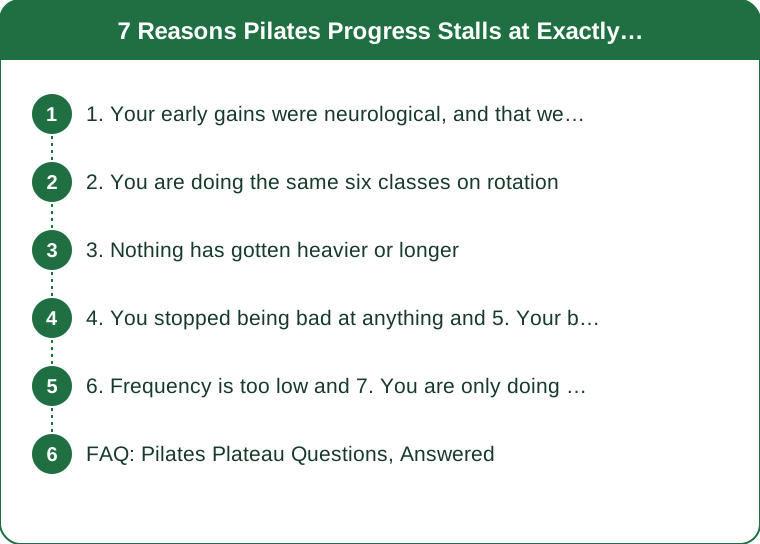
1. Your early gains were neurological, and that well runs dry
The first six to eight weeks of any new movement practice produce rapid improvement that has almost nothing to do with tissue change.
What improves is coordination: recruiting the right muscles, in the right order, with the right timing. This is motor learning, and it is fast. It is also finite. Once the pattern is learned, that source of improvement stops.
This is why the plateau feels sudden. You did not lose anything. A large contributor to your weekly progress simply completed its job.
The implication is that the thing that got you here will not get you further. Continued attendance maintains the learned pattern. It does not produce new adaptation. Something in the stimulus has to change.
2. You are doing the same six classes on rotation
Most studios and most apps build classes from a stable repertoire, which is good for learning and bad for progression after learning is done.
If you can predict the next exercise, your nervous system can too, and prediction is the opposite of stimulus. The body adapts to novelty and load, and a familiar sequence provides neither.
The fix is not chaos. It is deliberate variation on one axis at a time: a different instructor, a class one level up, a props-based class, or the same exercises in a different order.
An easy test: write down what you think the next five exercises will be at the start of your usual class. If you get four right, that class has become maintenance.
3. Nothing has gotten heavier or longer
Progressive overload applies to Pilates, and people resist this because Pilates is not framed as strength training.
In a reformer context the spring settings are the obvious lever, and a common mistake is staying on the same springs for months because that is what you were shown in week one. Lighter springs are harder for some exercises and easier for others; either direction can be progression depending on the movement.
On a mat, the levers are leg length, arm position, and range. Straightening a bent leg lengthens the lever and increases load substantially with no equipment at all.
Time under tension is the other axis. Taking a roll-up from three seconds to eight seconds is a meaningful increase in demand, and it costs nothing but willingness.

4. You stopped being bad at anything and 5. Your breathing went on autopilot
4. Comfort is the plateau’s main symptom
If every exercise in class is achievable, the class is calibrated below your capacity. Progress in any physical practice requires regularly attempting things you cannot yet do well.
There should be one or two exercises in a session that you genuinely struggle with. If there are none, that is not a sign of mastery, it is a sign of settling. Ask an instructor for the harder variation of your best exercise, not your worst one.
5. Breathing is where the effort quietly leaked out
The lateral breathing pattern is drilled hard for beginners and then, once it feels natural, most people stop attending to it.
The problem is that as exercises get harder, the breath tends to revert: held at the effort, shallow, or disconnected from the movement. Holding the breath raises intra-abdominal pressure and lets you cheat a movement with bracing rather than control, which is precisely the thing Pilates trains against.
Record yourself doing a hard exercise once. Most people are surprised to discover they stop breathing for the entire hardest repetition, and re-linking breath to movement often makes an exercise feel harder at the same load, which is the point.
6. Frequency is too low and 7. You are only doing Pilates
6. Twice a week is a maintenance dose
One to two sessions a week is enough to hold a level. Progression generally needs three, or two plus something supplementary at home.
This is the least popular item on the list and the most reliable. Ten focused minutes at home on two additional days changes the weekly stimulus more than upgrading your class does.
Pick two exercises you are worst at and do only those. Not a full session, not a video, just the two things standing between you and the next level.
7. Pilates alone leaves a strength ceiling
Pilates is excellent at control, mobility, and deep stabilizer recruitment. It is not designed to build maximal strength or bone density, and after a few months many people hit a ceiling that is genuinely outside what the method targets.
Adding even one short resistance session a week, with loaded hinges, squats, and carries, tends to unlock Pilates progress rather than compete with it, because several advanced exercises are gated by absolute strength that mat work does not develop.
This is not a criticism of Pilates. It is recognizing what a tool is for. The people who progress furthest in the studio are usually the ones doing something outside it.
This is general information, not medical advice. If a plateau comes with pain, get it assessed rather than progressing through it.
FAQ: Pilates Plateau Questions, Answered
How do I know if I am actually plateauing or just having a bad month?
Pick two objective markers, such as how long you can hold a teaser or how many controlled roll-ups you can do with straight legs, and test them monthly. Feelings about progress are unreliable; two numbers are not.
Should I switch to reformer if I have been doing mat?
It is a reasonable change of stimulus and gives you a load dial you did not have. But a harder mat class with longer levers and slower tempo provides much of the same benefit at a fraction of the cost, so try that first.
How long before a plateau should worry me?
Six to eight weeks of no change on your objective markers with unchanged training means the stimulus needs to change. Two weeks means nothing; that is normal variation.
TL;DR:
- Early progress is motor learning, which saturates in about eight weeks and then stops contributing
- Change one variable: spring load, lever length, tempo, rest, or class level
- Every session should contain one or two exercises you cannot do well yet
- Three sessions a week progresses, two maintains, and adding one strength session lifts the ceiling
Pick your two worst exercises and do them at home twice a week. That single change breaks most three-month plateaus within a month.
See It in Motion
Seen here: High Waist Printed Bootcut Yoga Pants with Pockets — shop it on bubblelime.com
Keep Reading
This article is for general informational and styling purposes only. Fit, sizing, and product availability may vary.