7 Reasons Pilates Feels Easier Standing Than Lying Down
Quick Answer: Standing Pilates lets you borrow stability from the floor, your legs, and decades of practised balance strategies. Lying down removes all of those and hands the entire job of stabilising your spine and pelvis to the deep core - with no way to cheat. That is why supine work exposes shaking, neck strain, and lost form that standing work hides entirely. It is not a fitness gap. It is a support gap, and it closes faster than you would think.
Seven specific reasons, and what each one tells you to work on.
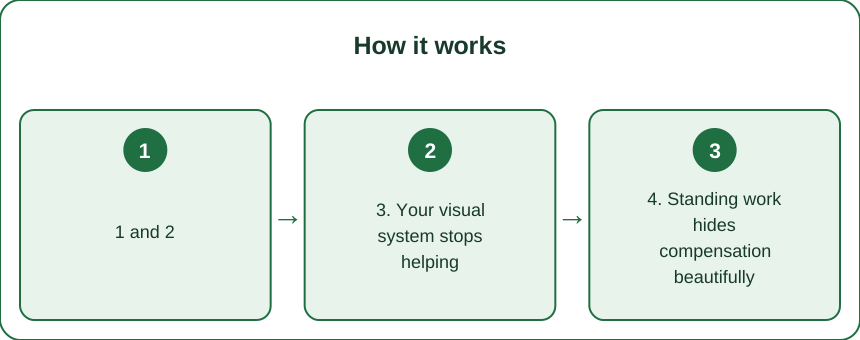
1 and 2: The floor disappears, and gravity changes direction
1. Standing lets you borrow stability from the floor
This is the largest single factor and it is mostly invisible.
When you stand, you have a closed kinetic chain through both feet. Ground reaction force runs up through your legs and pelvis, and your body uses that as a reference point for every movement above it. Your nervous system has spent your entire life refining this - it is the most practised skill you own.
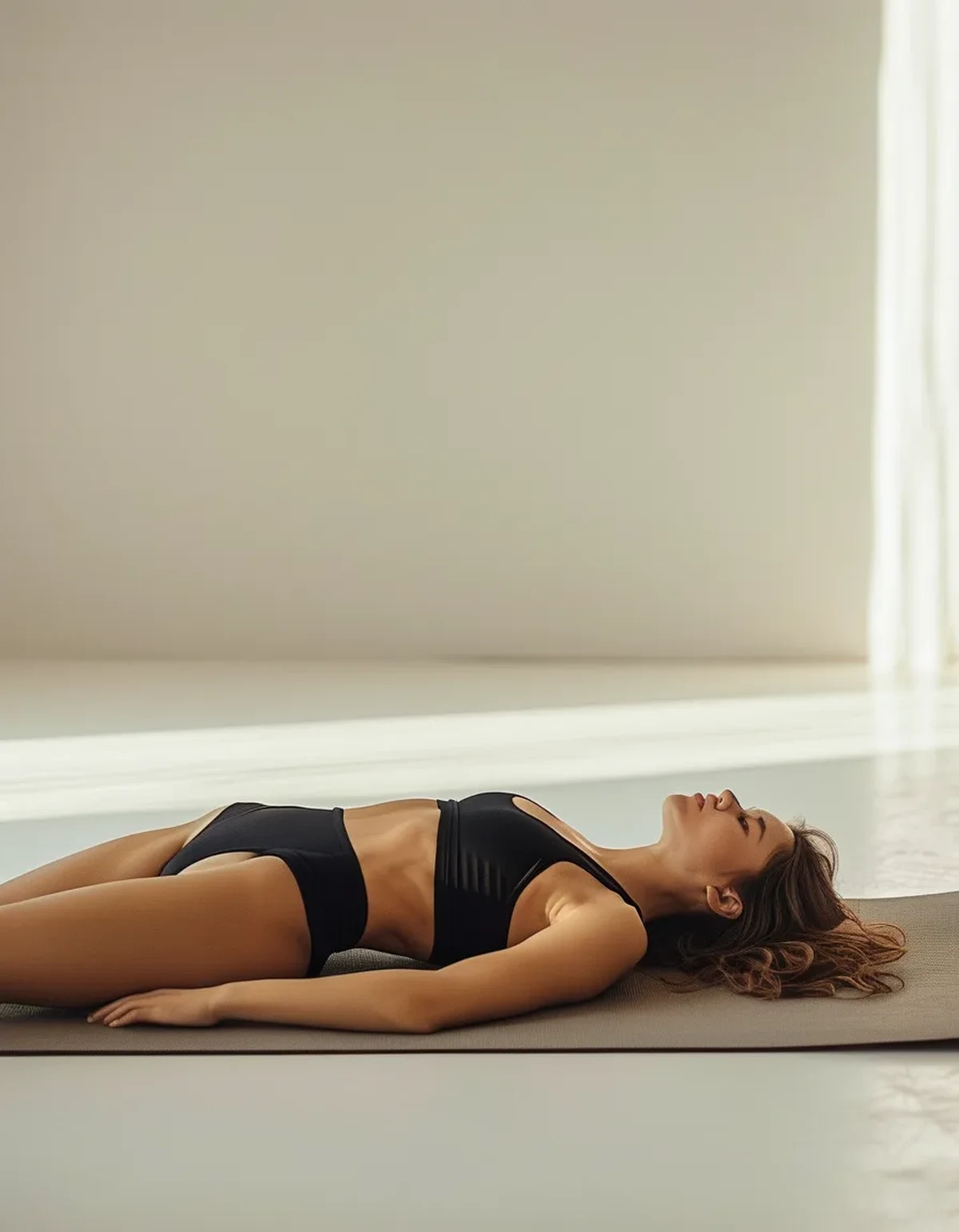
Lying supine, that reference disappears. Your only contact points are your back and, sometimes, your feet. There is nothing to push against, so stabilising the pelvis has to come entirely from muscular control rather than from structural support.
This is why the same exercise ‘feels’ completely different in the two positions. A leg lift standing is largely a hip flexor and balance task. The same leg movement lying down becomes an anti-extension task for the deep core, because nothing else is stopping your lower back from arching.
The practical read: if standing work is smooth and supine work is a mess, the deep stabilisers are the limiting factor, not your legs or your general fitness.
2. Gravity changes direction relative to your spine
Same force, entirely different job.
Standing, gravity compresses your spine along its length - a load your spine is structurally excellent at handling, with discs, curves, and posture doing most of the work passively.
Lying down, gravity acts perpendicular to your spine. Now it is a shear and bending load, and there is no passive structure that handles it for you. Muscle has to do the whole job.
This is why the lower back arches off the mat during leg work. Your legs are a long lever hanging off your pelvis, and gravity is pulling them down. The deep abdominals have to resist that pull to keep the pelvis neutral - and when they cannot, the back arches to compensate.
The tell: if you can only keep your back flat with your feet high in the air, your control point is high. Lower the legs a few degrees at a time and stop where you lose the position. That angle, not the exercise name, is your actual working level.
3. Your visual system stops helping
An underrated part of why supine work feels disorienting.
Standing balance is heavily visual. You orient constantly against the horizon, walls, and the mirror. Remove or change that reference and balance degrades immediately - which is why closing your eyes while standing on one leg is so much harder.
Lying on your back, you are looking at the ceiling. No horizon, no vertical reference, no visual feedback about whether your pelvis is level or your ribs are flared. You are working blind on positions you have never had to feel before.
This is a skill, and it develops. Proprioception - your internal sense of where your body is - improves measurably with practice, and supine Pilates is essentially proprioception training with resistance attached.
What helps immediately: hands on your ribs or hip bones so you get touch feedback instead of visual, and checking one specific landmark - usually whether your lower ribs stay down - rather than trying to monitor everything.
4. Standing work hides compensation beautifully
The uncomfortable one.
Standing, you have dozens of ways to complete a movement. Shift weight, rotate slightly, use momentum, grip with the toes, tilt the pelvis. Your body will always find the path of least resistance, and standing offers a lot of paths.
Lying down closes most of them. Fewer joints are free to move, so the muscle that is supposed to do the work has to actually do it. This is precisely why Pilates programmes lean so heavily on supine work - it is not tradition, it is that the position is honest.
Instructors correct the same thing repeatedly in supine work for this reason. The error was always there. The standing version just hid it.
How to use this: treat the position where you struggle as diagnostic information rather than failure. The exercise that exposes a compensation is the one worth doing, and it is telling you something the smooth exercises never will.
5. Your neck is suddenly load-bearing
The complaint that sends more people away from mat Pilates than any other.
Standing, your head sits balanced on top of your spine - roughly 10 to 12 pounds held by structure, not effort.
Lift your head off the mat and the deep neck flexors must hold that weight against gravity. These are small endurance muscles, and in most people they are undertrained and fatigue within seconds. When they fail, the larger superficial neck muscles take over, and that is the burning strain you feel.
Critically, neck strain in ab work usually means the abdominals disengaged, not that your neck is weak. The head comes up as a substitute for the curl, rather than as a result of it.
The fixes, in order of usefulness: keep your head down entirely and do the exercise with a neutral neck; support your head with one hand; or reduce the range so the abdominals stay engaged the whole time. All three beat pushing through - pushing through only trains the compensation.
6. Breathing mechanics change when you lie down
Quietly significant, rarely mentioned.
Lying supine, the weight of your abdominal contents presses up against the diaphragm, and your back is fixed against the mat so the ribs cannot expand backward as freely. Breathing genuinely takes more effort in this position, particularly lateral rib expansion, which is exactly what Pilates asks for.
Standing, the diaphragm has an easier job and rib movement is unrestricted in all directions. So the breathing pattern you have finally mastered standing can fall apart lying down - and breath-holding follows, which spikes pressure and undermines the core work you are trying to do.
This also explains why the same class feels harder after a big meal, and why supine work early in the morning often feels different from the same work in the evening.
What to do: re-establish the breath before adding the movement. Three or four full breaths lying still, feeling the ribs widen sideways, before the first repetition. If the breath disappears mid-exercise, that is the stop signal - not the burn.
7. The demand is genuinely higher, not just different
Worth stating plainly, because people assume they are failing at something easy.
Supine core work asks for sustained isometric control at low load over long durations - a different quality from the short, dynamic efforts most fitness training builds. Endurance in deep stabilisers is trainable but slow, typically showing meaningful change over six to eight weeks rather than in a fortnight.
Meanwhile the exercises look easy. No weight, no jumping, small movements. The gap between how an exercise looks and how it feels is wider in Pilates than in almost any other discipline, which is why experienced athletes routinely struggle in their first classes and take it personally.
And progress shows up in an unexpected place first. People notice they can hold positions longer and shake less before they notice any change in strength elsewhere. Reduced shaking is the actual progress marker in this kind of work.
The practical structure: two to three supine sessions a week, short holds done well rather than long holds done badly, and the same handful of exercises repeated long enough to actually improve at them. Variety is the enemy of progress in stability work.
If you have persistent neck pain, low back pain, a recent injury, or you are pregnant or postpartum, work with a qualified instructor who can see your positions - some supine exercises need genuine modification. This is general information, not medical advice.
FAQ: Standing vs Supine Pilates, Answered
Am I weak if supine work is much harder than standing work?
No - the positions test different things. Standing lets you borrow stability from the floor and your legs. Supine hands the whole job to the deep core with no substitutes available.
Should I just do standing Pilates instead?
Standing work is genuinely valuable, but skipping supine work means skipping the position that exposes and trains deep stability best. Modify the supine work rather than avoiding it.
Why does my neck always hurt in mat ab work?
Most often because the abdominals disengaged and the head lifted as a substitute. Keep the head down, support it with a hand, or reduce the range until the abdominals can hold the position.
How long until supine work stops feeling impossible?
Coordination improvements often appear within two to three weeks. Genuine endurance changes in the deep stabilisers usually take six to eight weeks of consistent practice.
Is shaking a bad sign?
Shaking generally means the muscle is working near its current capacity - not dangerous in itself. Shaking that comes with lost position, held breath, or pain is the signal to reduce the range.
Does it matter what time of day I do mat work?
A little. Spinal discs are more hydrated in the morning, so some people find flexion work less comfortable then, and supine breathing is harder soon after eating. Consistency matters far more than timing.
TL;DR:
- Standing lets you borrow stability from the floor and your legs; lying down removes every substitute and hands the job to the deep core.
- Gravity acts along the spine standing and across it lying down - the second is a purely muscular job.
- Supine work removes visual balance references, so it is proprioception training as much as strength training.
- Standing hides compensation; supine exposes it. The exercise that reveals a fault is the one worth doing.
- Neck strain in ab work almost always means the abdominals let go - drop the head or reduce the range rather than pushing through.
- Breathing is mechanically harder supine, so re-establish the breath before adding movement.
- Deep stabiliser endurance takes six to eight weeks; less shaking is the real progress marker, not more reps.
Supine work is not harder because you are worse at it. It is harder because it finally asked the right question.
This is general information, not medical advice.
See It in Motion
Seen here: High Waist Bootcut Yoga Pants with Hidden Pocket — shop it on bubblelime.com
Keep Reading
This article is for general informational and styling purposes only. Fit, sizing, and product availability may vary.