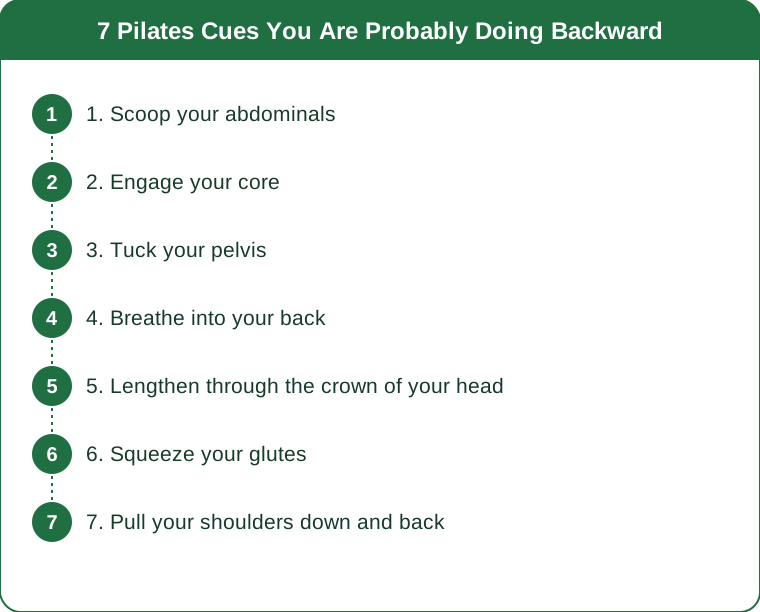
7 Pilates Cues You Are Probably Doing Backward
Quick Answer: Most Pilates cues are metaphors that describe a sensation, not a literal instruction. Scoop, engage your core, tuck your pelvis, and breathe into your back all get taken literally, which produces exactly the compensation the cue was designed to prevent. Here are the seven worst offenders.
You have been going to class for two years. You do what the instructor says. But the movements have stopped changing anything, and something in your low back has opinions about the hundred. The problem is usually not effort. It is that a cue meant to evoke a feeling got translated into a physical action.
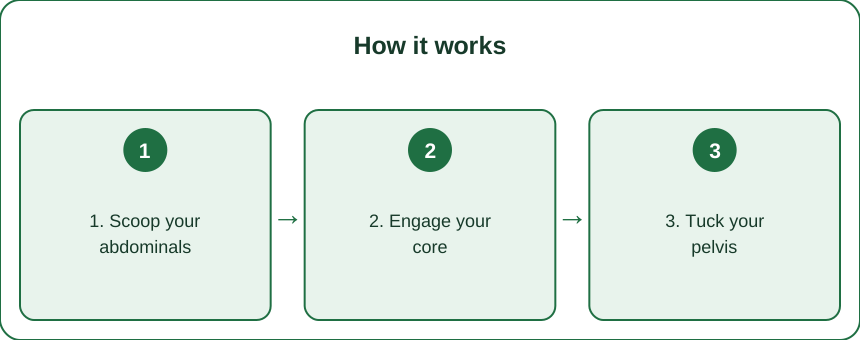
1. Scoop your abdominals
What people do: suck the belly in as hard as possible and hold it, often while holding their breath.
What it means: create a gentle drawing-in of the deep abdominal wall — the transverse abdominis — while continuing to breathe normally. The target is something like 20 to 30% of maximum effort, not 100%.
Maximal bracing does the opposite of what Pilates wants. It recruits the outer abdominal layers, flattens the natural spinal curves, and makes the diaphragm’s job nearly impossible.
The test: if you cannot say a full sentence out loud while holding the scoop, you are gripping rather than engaging. Back off until speech is easy, and notice that the deeper support is still there.
2. Engage your core
What people do: clench everything from ribs to hips, usually including the glutes and often the jaw.
What it means: create coordinated tension between the deep abdominals, the pelvic floor, the diaphragm, and the deep back muscles — a canister that manages pressure rather than a fist that squeezes.
The distinguishing feature of true core engagement is that it is responsive. It changes with the demand of the movement rather than staying locked at one intensity throughout.
A useful reset: exhale fully, and notice the low-grade tension that appears near the end of the exhale. That is roughly the sensation. Now inhale without losing it. That is core engagement — a floor you do not drop below, not a ceiling you press against.
3. Tuck your pelvis
What people do: posteriorly tilt the pelvis aggressively, flattening the low back into the mat and often lifting the tailbone off the floor.
What it means: in most exercises, find and maintain a neutral pelvis — the position where your pubic bone and the two front hip points sit in roughly the same plane. Imprinted or tucked positions are used deliberately in specific exercises, not as a default.
Aggressive tucking shortens the hip flexors, switches off the deep stabilizers you are trying to train, and puts the lumbar spine into sustained flexion.
How to find neutral: lie on your back, knees bent, and rock the pelvis fully forward and fully back a few times. Neutral is the middle of that range, where you can slide a flat hand under your low back but not a fist.
4. Breathe into your back
What people do: try to force air backward, usually by puffing the chest and lifting the ribs.
What it means: allow the lower ribcage to expand three-dimensionally — sideways and backward as well as forward. The lungs do not move; the ribcage does.
Pilates uses lateral or posterior breathing so the abdominal wall can stay gently engaged while you still get a full breath. If you breathe only into the belly, you lose that engagement on every inhale.
The drill: wrap a scarf or towel around your lower ribs, hold the ends crossed in front, and inhale to push outward against it. That sensation — ribs widening, belly relatively quiet — is what the cue is asking for. Most people feel it in about three breaths and then wonder why nobody explained it that way.
5. Lengthen through the crown of your head
What people do: lift the chin and extend the neck, which shortens the back of the neck and compresses exactly what the cue was trying to decompress.
What it means: create axial length through the whole spine, with the head balanced on top. The crown of the head is the very top of the skull, not the forehead — the direction is straight up, not up and forward.
The correction is usually to think about the back of the neck lengthening and the chin staying level, or very slightly tucked. If you can still swallow comfortably and your gaze has not lifted, you are in the right place.
This cue matters more than it looks, because neck position influences the whole chain. A jutted chin in the hundred is one of the most common reasons people feel that exercise in their neck instead of their abdominals.
6. Squeeze your glutes
What people do: clench maximally, which posteriorly tilts the pelvis and takes the hamstrings and low back out of the movement.
What it means: use the glutes as the primary hip extensor at whatever intensity the movement requires, which in most Pilates work is moderate.
Maximal glute clenching in bridging and leg work creates the tuck problem from cue three all over again. It also tends to over-recruit the upper glute and hip rotators, which is why some people finish a mat class with tight hips rather than open ones.
Better internal cue: think about pressing the floor away with your heels in bridging rather than squeezing anything. The glutes will do their job, the pelvis stays neutral, and the hamstrings get to participate.
7. Pull your shoulders down and back
What people do: depress the shoulder blades hard and pin them together, holding that position through every exercise regardless of what the arms are doing.
What it means: avoid shrugging and avoid rounding — find a mid-range, mobile scapular position that can move when the arms move.
The shoulder blade is supposed to travel. It rotates upward as the arm lifts overhead, and pinning it down actively blocks that rotation, which is a genuine route to shoulder impingement over time.
The better instruction is to let the shoulder blades rest wide on the ribcage and allow them to glide with the arms. If someone cues you to hold them down and back while your arms go overhead, that is one to quietly modify.
This is general information rather than medical advice — if a movement produces shoulder pain, a physiotherapist who knows your history is the right person to ask.
TL;DR:
- Most Pilates cues describe a sensation and break when taken literally
- Scoop and engage mean 20 to 30% effort with normal breathing, not maximal bracing
- Neutral pelvis is the default; tucking is a specific tool, not a starting position
- Breathe into the sides and back of the lower ribs, keep the chin level, and let the shoulder blades move
None of this means your instructor is wrong. Cues are shorthand built for a room of thirty people, and they work beautifully for the students who happen to interpret them the way they were meant. If a cue has never quite clicked for you, it is usually worth asking what sensation it is aiming for — the answer tends to change the exercise immediately.
See It in Motion
Seen here: Super High Waist Embossed Yoga Leggings with Inner Pocket — shop it on bubblelime.com
Keep Reading
This article is for general informational and styling purposes only. Fit, sizing, and product availability may vary.